Opinion: Your Phone Is Ruining Your Life -- Especially if You’re an ADHDer
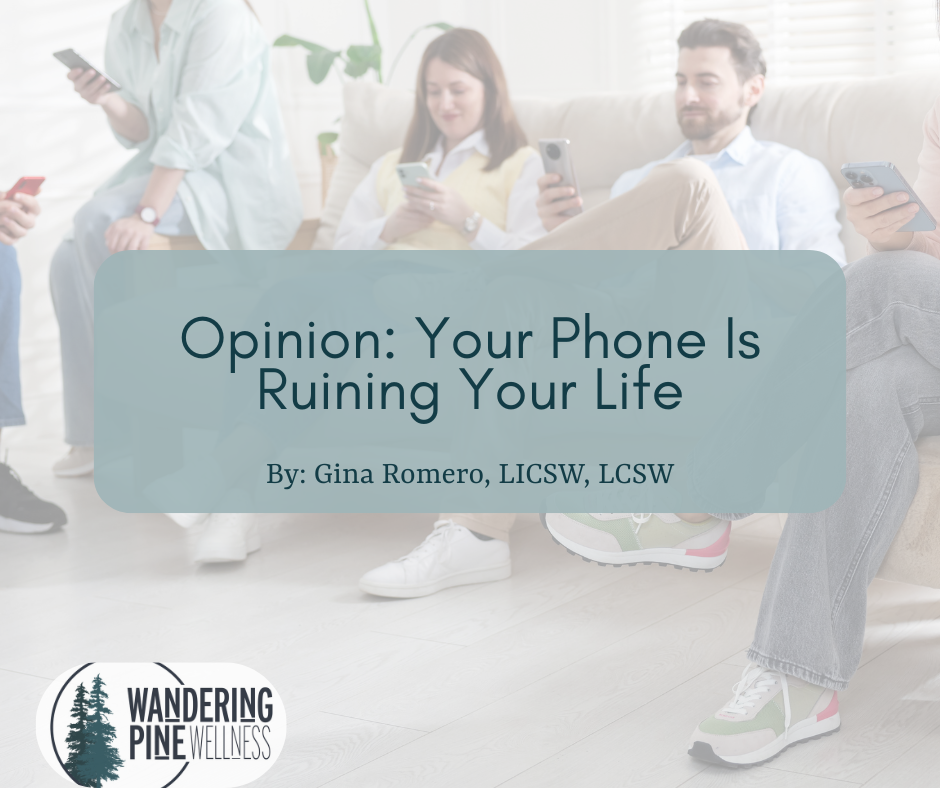
By: Gina Romero, LICSW, LCSW
Your phone isn’t just a distraction… it’s much worse. An ADHD therapist explains how smartphones sabotage motivation, emotional regulation, and focus.
You’re Probably Addicted to Your Phone
I’m going to say what you already know but don’t want to admit: your phone owns you.
You check it first thing in the morning, mindlessly scroll through social media before you’ve even had water, and somehow “just five minutes” turns into an hour-long TikTok trance. Now you’re running behind, and you have to cut something out of your morning routine to make it to work on time. You decide to cut out breakfast, opting instead for coffee on the go. The caffeine makes you anxious on an empty stomach (you know it will, but you do it anyways). You wash, rinse, and repeat the next day.
As a therapist, I see this all the time. Especially in my work with ADHDers.
Clients say things like, “I can’t focus, I can’t finish anything, my brain feels fried.” Yeah, it’s not just you. Your brain is being hacked by a multi-billion-dollar attention economy that wants you distracted.
Your phone isn’t the productivity tool that you think it is.

.
ADHD and the Dopamine Trap
ADHD brains run on dopamine, the neurotransmitter that makes things feel rewarding. However, ADHDers naturally have a dopamine deficit. That’s why we’re constantly chasing dopamine in an attempt to feel “normal.”
And our phones? They figured that out before we did.
Every notification, “like”, and message gives you a micro-dose of dopamine. A quick little hit that tells your brain, “That felt good, do it again.” So you do. Again. And again. Until you look up and wonder how your bathroom break lasted 30 minutes, or why your coffee went cold an hour ago.
Adult ADHD and smartphone addiction show a significant negative effect on well-being.
So when you try to do something boring like paying your bills or scheduling a doctors appointment, your brain says, “Nah, let’s check Facebook again. I probably have more likes on my new profile picture!”
Executive Functioning
You’ve probably heard the term “executive functioning.” While it’s thrown around casually, it’s actually a real thing, not just a buzzword that Instagram and Tik Tok users say. If your brain is the CEO of your life, think of executive functioning as your body’s inner-management system. It helps you prioritize, plan, and stay on track…until it doesn’t. Now picture that management team trying to run a company where a clown barges into the office every 30 seconds yelling, “LOOK! A new meme!”
Spoiler alert: that “clown” is your phone.
Every ping, buzz, and notification stops your focus and shatters your momentum. If you’re an ADHDer, you already struggle with memory and task initiation. And your phone makes this exponentially worse. Before you know it, you’ve got 43 open tabs, three half-written texts, 5 “draft” emails, and zero completed tasks.
*Cue the shame spiral.*
And what do you do to numb that shame? You scroll more.

Make it stand out
Social Media, aka “Las Vegas” for your brain
Social Media: Las Vegas for your Brain
Another way to think of social media and its impact on your brain is this: social media is like Las Vegas for your brain. Scrolling is like an endless supply of slot pulls. You may not even be interested in what you’re looking at, but you also can’t stop.
Did you know that developers of social media apps spend millions of dollars to make their apps more addictive? The fact that you keep scrolling day after day is evidence of this. For ADHDers, the addictive nature of these apps has a bigger impact. The quick results, the colors, the sounds…they were tailor-made for a dopamine-hungry brain. One study found that these apps were designed to reinforce phone-checking habits.
So, How Do You Break the Spell? 5 Tips
Since you can’t just toss your phone in the trash and never use it again (even if part of you wants to), you can retrain your brain to stop treating your phone like a dopamine IV drip.
Here’s how I work with clients who want to decrease their phone use:
1: Take a good look at your screen time, even if it feels scary. Start by taking a guess at your average daily and weekly screen times, then look at what it actually is. Almost all phones provide you with the ability to see an overview of your screen time. Was this number close to what you thought it would be? If not, what’s the discrepancy?
2: Take note of your “autopilot”. Notice when you reach for your phone and why. Is it boredom? Avoidance? Anxiety? Just naming it kills a lot of that power.
3: Stop looking at your phone first thing in the morning. Avoid looking at your phone for the first 45-60 minutes that you’re awake.
4: Make your phone boring. Can you remove some of the apps that you spend the most time on, and use them on the computer instead? Can you remove games and other apps that waste your time? Can you change the color settings so it’s less visually appealing?
5: Add some obstacles. Bury your time-sucking apps in a folder within another folder. Put your phone in the other room while you’re working, or doing other activities that require your attention.
6: Find better dopamine. Replace that endless scrolling with stuff that gives real rewards: movement, music, creativity, connecting with an actual human, spending time with your pets.
Closing Thoughts
I’m not anti-technology. Phones are useful, sometimes even life‐saving. But pretending they’re harmless? Not helpful. And for ADHDers, the price is higher. Us ADHDers already fight an uphill battle with focus, motivation, and self-regulation. So stop letting your phone run the show!
I hope that this post helped you take a step toward reclaiming your attention from companies that are really really good at stealing it.
FAQ
1. How do I know if I'm actually addicted to my phone?
Do you check it compulsively, scroll when you’re not even interested, or panic when it’s not nearby?
2. Does phone use really make ADHD worse?
Your phone feeds into distractibility, impulsivity, and emotional dysregulation. Since executive function is already hard for ADHDers, your phone exacerbates those challenges.
3. What’s the best way for ADHDers to cut back without going cold turkey?
Start small: remove one app, set one boundary, reclaim one hour. Momentum builds faster than you think.
4. Are there “good” apps for ADHDers?
Sure, as long as you use them intentionally. I made a list of recommended apps (and other tools) for ADHDers. You can find it here: https://www.wanderingpinewellness.com/new-adhd-diagnosis
6. Are you accepting new clients?
We’re always accepting new clients. Request an appointment here: https://www.wanderingpinewellness.com/contact-us
At Wandering Pine Wellness, we offer therapy for individuals navigating anxiety, stress, trauma, life transitions, and the emotional impact of uncertainty. Our work often focuses on helping clients understand their nervous system, develop grounding and coping tools, and build a more compassionate relationship with themselves.
If you’re interested in learning more or would like to schedule an appointment, we invite you to reach out and connect with our team. We’re here to meet you with care, understanding, and support.

Gina Romero is a licensed therapist in Las Vegas, NV, offering therapy to adults in Washington, Nevada, and Colorado. She specializes in adult ADHD. Learn more about Gina here: